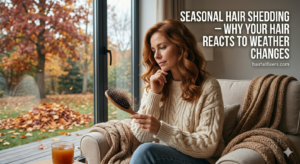
Seasonal Hair Shedding – Why Your Hair Reacts to Weather Changes
🌟 A Familiar Story
Every autumn, Ananya noticed her hairbrush filling faster than usual. She panicked, thinking her shampoo was to blame. But her dermatologist reassured her: “It’s seasonal shedding. Perfectly natural.”
Hair fall isn’t always about stress, diet, or products. Sometimes, it’s simply the seasonal rhythm of your body. This article explores why hair reacts to weather changes, the science behind it, and how you can manage it without fear.
🧠 The Science of Seasonal Hair Shedding
Hair Growth Cycle Recap
- Anagen (Growth) – 2–7 years
- Catagen (Transition) – 2–3 weeks
- Telogen (Resting) – 3–4 months
Seasonal changes influence the telogen phase, leading to temporary shedding.
Why Seasons Matter
- Summer: UV exposure damages follicles.
- Monsoon: Humidity weakens roots.
- Winter: Dry air causes brittle strands.
- Autumn: Natural shedding peak due to evolutionary biology.
📊 Chart: Seasonal Hair Shedding Trends
| Season | Common Hair Issue | Shedding Level |
|---|---|---|
| Summer | UV damage, sweat | Moderate |
| Monsoon | Humidity, fungal infections | High |
| Autumn | Natural shedding cycle | Very High |
| Winter | Dryness, dandruff | Moderate |
📖 Case Study 1: Autumn Shedding
A study in Sweden found that women shed more hair in late summer and autumn. This is linked to evolutionary biology—hair thickens in summer to protect the scalp, then sheds in autumn.
🔍 Weather and Hair Biology
- Temperature Fluctuations → Stress on follicles.
- Humidity → Weakens keratin bonds.
- Dry Air → Causes breakage.
- Sunlight (UV Rays) → Damages scalp cells.
📈 Graph: Seasonal Stress vs Hair Fall
Summer: UV damage → Moderate shedding
Monsoon: Humidity → High shedding
Autumn: Natural cycle → Peak shedding
Winter: Dryness → Moderate shedding
📝 Interactive Quiz: Which Season Affects You Most?
- Do you notice more hair fall during monsoon showers?
- Does your scalp feel itchy or flaky in winter?
- Do you see more shedding in autumn months?
- Does summer sun make your hair brittle?
Results:
- Mostly “Yes” to 1 → Monsoon shedding.
- Mostly “Yes” to 2 → Winter dryness.
- Mostly “Yes” to 3 → Autumn shedding.
- Mostly “Yes” to 4 → Summer damage.
🛠️ Coping Strategies by Season
🌞 Summer
- Use UV-protective hair sprays.
- Hydrate with aloe vera masks.
- Wear hats outdoors.
🌧️ Monsoon
- Keep scalp dry, avoid fungal infections.
- Use mild antifungal shampoos.
- Avoid tying wet hair.
🍂 Autumn
- Accept natural shedding as temporary.
- Focus on scalp massages to stimulate regrowth.
- Maintain protein-rich diet.
❄️ Winter
- Oil massages to combat dryness.
- Humidifiers indoors.
- Anti-dandruff shampoos.
📊 Table: Seasonal Hair Care Routine
| Season | Key Practice | Benefit |
|---|---|---|
| Summer | UV protection | Prevents sun damage |
| Monsoon | Antifungal care | Reduces infections |
| Autumn | Scalp massage | Stimulates regrowth |
| Winter | Oil massage | Prevents dryness |
📖 Case Study 2: Monsoon Shedding in Arizona
Rita, a 32-year-old teacher, noticed severe shedding during monsoon. Her dermatologist explained that humidity weakens roots and promotes fungal growth. With antifungal shampoo and scalp hygiene, her shedding reduced within weeks.
🌱 Holistic Approach
Nutrition
- Summer: Hydrating foods (cucumber, watermelon).
- Monsoon: Vitamin C for immunity.
- Autumn: Protein-rich foods (eggs, lentils).
- Winter: Omega-3 fatty acids for scalp health.
Ayurveda
- Bhringraj oil for autumn shedding.
- Neem oil for monsoon scalp infections.
- Coconut oil for winter dryness.
📊 Chart: Seasonal Nutrition for Hair
| Season | Nutrient Focus | Food Sources |
|---|---|---|
| Summer | Hydration | Watermelon, cucumber |
| Monsoon | Immunity | Citrus fruits |
| Autumn | Protein | Eggs, lentils |
| Winter | Omega-3 | Flaxseeds, walnuts |
📖 Case Study 3: Winter Dryness in New York
A banker in New York faced brittle hair every winter. By adding omega-3 supplements and using coconut oil massages, she reduced breakage by 60%.
🧩 Diagram: Seasonal Hair Care Cycle
Summer → Protect from UV
Monsoon → Prevent infections
Autumn → Accept shedding, massage scalp
Winter → Moisturize and nourish
🧾 Emotional Impact:
Seasonal shedding often causes panic. People switch shampoos endlessly, thinking something is wrong. But understanding the natural rhythm of hair helps reduce anxiety.
📚 References (General)
- Journal of Dermatological Science: Seasonal Hair Shedding Patterns
- American Academy of Dermatology: Hair Growth Cycle
- Indian Journal of Dermatology: Monsoon Hair Fall Trends
🎯 Conclusion
Seasonal hair shedding is natural, temporary, and manageable. By understanding how weather affects your hair, you can adopt the right care routine for each season. Remember: shedding is part of your body’s rhythm, not a permanent loss.
What climate is best for hair?
The best climate for healthy hair is mild, balanced, and moderately humid — extremes of dryness, humidity, heat, or cold can damage hair. A temperate environment with clean air and moderate moisture helps maintain scalp hydration, reduces frizz, and minimizes breakage.
🌦️ How Climate Affects Hair
☀️ Hot & Dry Climates
- Impact: Strips natural oils, causes dryness, split ends, and brittle strands.
- Care Tip: Use hydrating masks, coconut/argan oil, and cover hair outdoors.
🌊 Humid & Coastal Climates
- Impact: Excess moisture causes frizz, dandruff, and fungal scalp issues.
- Care Tip: Anti-frizz serums, lightweight conditioners, and regular scalp cleansing.
❄️ Cold & Hill Climates
- Impact: Cold air + indoor heating → dryness, static, and scalp flaking.
- Care Tip: Deep conditioning, warm oil massages, and protective hairstyles.
🏙️ Polluted Urban Climates
- Impact: Dust, smoke, and toxins weaken follicles and dull hair.
- Care Tip: Wash regularly, use antioxidant-rich products, and cover hair when commuting.
📊 Climate vs. Hair Health
| Climate Type | Hair Impact | Best Practices |
|---|---|---|
| Dry/Arid | Brittle, split ends | Hydration, oils |
| Humid/Coastal | Frizz, dandruff | Anti-frizz care, scalp hygiene |
| Cold/Hill | Dry scalp, static | Deep conditioning, warm oils |
| Polluted Urban | Weak, dull hair | Antioxidants, protective cover |
🌍 Ideal Climate for Hair
- Moderate humidity (40–60%) → keeps scalp hydrated without excess frizz.
- Mild temperatures (15–25°C) → reduces stress on follicles.
- Clean air quality → prevents buildup of pollutants on scalp.
- Balanced sunlight → supports vitamin D production without UV damage.
⚠️ Risks of Extreme Climates
- Excessive heat: Accelerates oil loss and breakage.
- High humidity: Encourages fungal infections and frizz.
- Cold winds: Cause dryness and scalp irritation.
- Pollution: Leads to oxidative stress and hair thinning.
📝 Summary
The best climate for hair is temperate, moderately humid, and clean — extremes of heat, cold, dryness, or humidity accelerate hair fall and damage. For readers in India and the U.S., adapting hair care routines to local climates (hydration in dry regions, anti-frizz in humid areas, deep conditioning in cold zones, and antioxidant protection in polluted cities) is essential for maintaining strong, healthy hair. 🌿✨
Is losing 700 hairs a day normal?
No — losing 700 hairs a day is not normal.
On average, a healthy person sheds 50–100 hairs per day as part of the natural hair growth cycle. Shedding around 700 hairs daily is considered excessive hair loss and may indicate an underlying issue such as:
⚠️ Possible Causes of Excessive Hair Loss
- Telogen Effluvium: Stress, illness, or hormonal changes push more hairs into the shedding phase.
- Nutritional Deficiencies: Lack of iron, vitamin D, zinc, or protein weakens follicles.
- Hormonal Imbalances: Thyroid disorders, PCOS, or postpartum changes.
- Medical Conditions: Autoimmune disorders (like alopecia areata).
- Medications: Certain drugs (antidepressants, blood thinners, chemotherapy).
- Chemical Damage: Frequent dyes, relaxers, or harsh treatments.
📊 Normal vs. Excessive Hair Shedding
| Hair Shedding | Count per Day | Meaning |
|---|---|---|
| Normal | 50–100 | Natural cycle |
| Moderate | 150–300 | Could be stress or temporary |
| Severe | 500+ | Likely medical or nutritional issue |
| Extreme | 700+ | Needs professional evaluation |
🧾 What To Do If You’re Losing 700 Hairs Daily
- Track shedding over several days to confirm consistency.
- Review recent stress, illness, or lifestyle changes.
- Improve diet with protein, iron, and vitamins.
- Avoid harsh chemical treatments and heat styling.
- Consult a dermatologist or trichologist for diagnosis and treatment.
📝 Summary
Losing 700 hairs per day is excessive and not normal. While mild shedding is part of the natural cycle, such high levels usually point to stress, nutritional deficiencies, hormonal imbalance, or medical conditions. Seeking professional help is the best step to identify the root cause and prevent long-term thinning. 🌿✨
Climate-specific hair care guide:
Here’s a climate-specific hair care guide you can share with your readers. It’s structured to cover different environments and give practical routines for each.
🌦️ Climate-Specific Hair Care Guide
☀️ Hot & Dry Climates (Deserts, Arid Regions)
Impact on Hair:
- Strips natural oils → dryness, split ends, brittle strands.
- UV exposure → weakens keratin, fades color.
Care Routine:
- Use hydrating shampoos & conditioners (sulfate-free).
- Weekly deep oil treatments (coconut, argan, jojoba).
- Wear hats/scarves outdoors to protect from sun.
- Avoid daily heat styling — hair is already stressed.
🌊 Humid & Coastal Climates
Impact on Hair:
- Excess moisture → frizz, limp strands.
- Scalp issues → dandruff, fungal infections.
Care Routine:
- Use anti-frizz serums and lightweight conditioners.
- Wash scalp regularly with clarifying shampoo to prevent buildup.
- Dry hair completely before tying up to avoid fungal growth.
- Opt for hairstyles that minimize frizz (braids, buns).
❄️ Cold & Hill Climates
Impact on Hair:
- Cold air + indoor heating → dryness, static, scalp flaking.
- Reduced circulation → slower growth.
Care Routine:
- Weekly warm oil massages (olive, almond oil).
- Use leave-in conditioners to fight static.
- Protect hair with wool caps lined with silk/satin.
- Avoid very hot showers — they strip oils.
🏙️ Polluted Urban Climates
Impact on Hair:
- Dust, smoke, and toxins → dullness, weak follicles.
- Increased oxidative stress → premature thinning.
Care Routine:
- Wash hair regularly with antioxidant-rich shampoos (green tea, vitamin E).
- Rinse hair with filtered water if possible.
- Cover hair during commutes (scarves, caps).
- Include antioxidant foods (berries, spinach, nuts) in diet.
📊 Quick Comparison Table
| Climate Type | Hair Impact | Best Practices |
|---|---|---|
| Dry/Arid | Brittle, split ends | Hydration, oils |
| Humid/Coastal | Frizz, dandruff | Anti-frizz care, scalp hygiene |
| Cold/Hill | Dry scalp, static | Deep conditioning, warm oils |
| Polluted Urban | Weak, dull hair | Antioxidants, protective cover |
🌍 Ideal Climate for Hair
- Moderate humidity (40–60%) → keeps scalp hydrated without excess frizz.
- Mild temperatures (15–25°C) → reduces stress on follicles.
- Clean air quality → prevents buildup of pollutants.
- Balanced sunlight → supports vitamin D without UV damage.
📝 Summary
The best climate for hair is temperate, moderately humid, and clean. But since most of us live in diverse environments, adapting hair care routines to local climates is essential.
- In dry regions, focus on hydration.
- In humid areas, fight frizz and scalp buildup.
- In cold climates, protect against dryness and static.
- In polluted cities, prioritize cleansing and antioxidants.
🌿✨ With climate-specific care, your readers can keep their hair strong, shiny, and resilient no matter where they live.
About The Author